Underwrite before you commit
The figures in this post are checked against Dubai Land Department records and RERA filings. Get an independent underwriting score on any project, or ask Javier on WhatsApp.
Business Bay Off-Plan in 2026: What to Know Before You Sign
Business Bay
has 38 active developments under construction as of Q1 2026 and a further 22 announced for 2026 launch. Combined, these will deliver roughly 12,400 new residential units across 2026 to 2029. The off-plan strategy in Business Bay carries different risk and return mechanics than the secondary market and requires understanding of payment plan structures, handover timing, and developer track record.
This guide maps the active 2026-2029 Business Bay handover timeline, breaks down the standard payment plan structures (70/30, 60/40, 80/20, 90/10, post-handover), and explains how to evaluate any specific Business Bay off-plan opportunity. Per RERA and DLD project status registry, all numbers are Q1 2026.
Use this as a working framework. Specific project terms change with launch promotions and developer pipeline. Confirm current payment plan terms directly with the developer or a RERA-registered broker before signing. Past performance does not guarantee future returns.
2026 to 2029 Handover Timeline
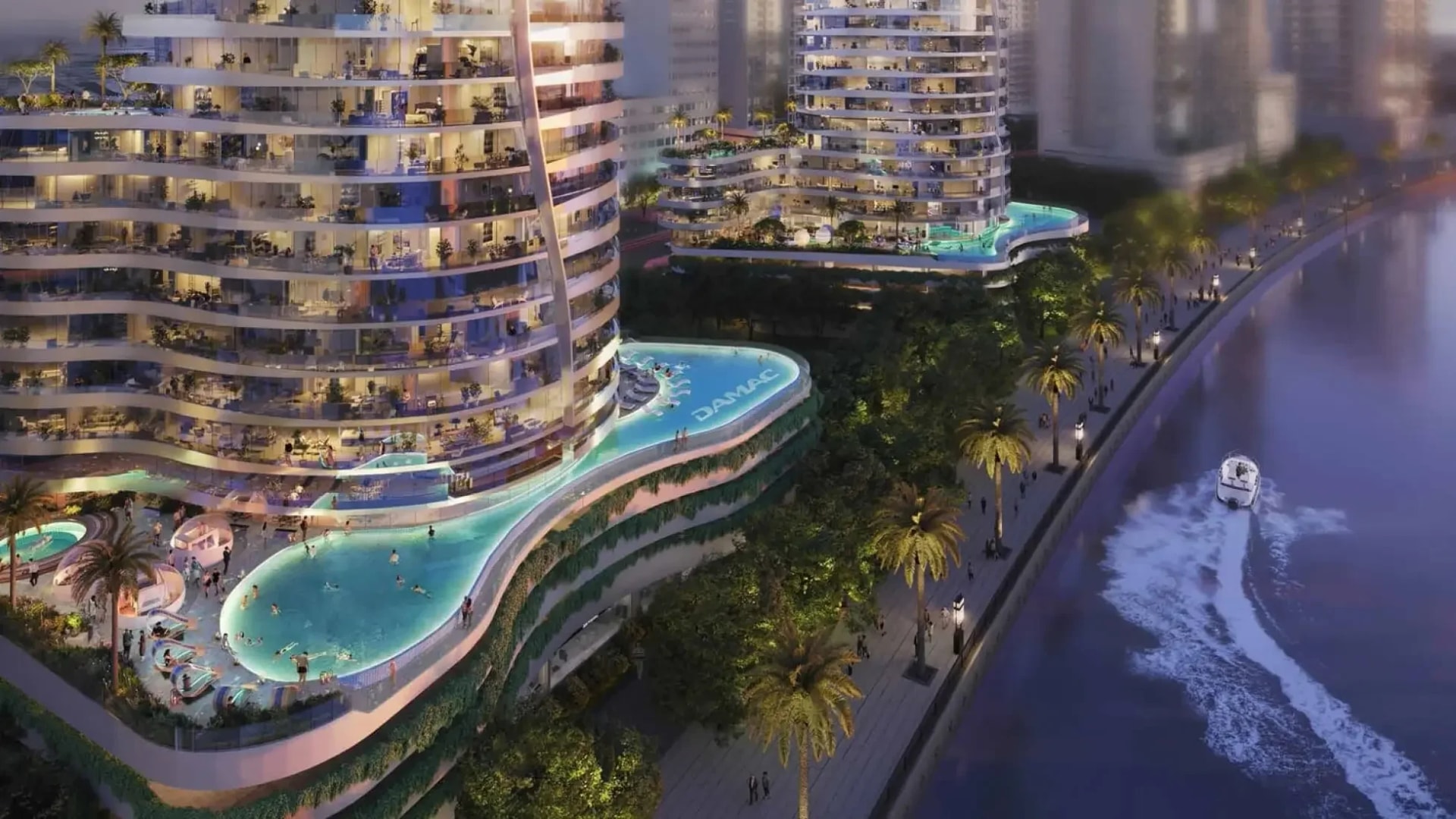
2026 Q2 to Q4 handovers (12 projects): Volta (Damac, canal-front branded), Cavalli Tower (Damac, branded), Peninsula 4 and 5 (Select Group, canal-front), Sobha Hartland Greens phases (Sobha, Hartland-adjacent), Mada Residences (Artal, mid-market), Aykon Heights (Damac), Bayz 101 (Danube, mid-market), Binghatti Mercedes-Benz Phase 1 (Binghatti, branded), Mag 318 phase 2 finishes, two Tiger Properties launches.
2027 Q1 to Q4 handovers (14 projects): Bugatti Residences (Binghatti, ultra-prime branded), Dorchester Collection (Omniyat, ultra-prime), Damac Bay 3 (Damac, canal-front), Peninsula 6 (Select), Sobha Hartland 2 launch towers, Tonino Lamborghini residential, Azizi multiple launches, Binghatti Mercedes-Benz Phase 2, Aldar Business Bay launch tower, two Deyaar mid-market tower completions.
2028 to 2029 handovers (12 projects): Multiple southern Business Bay launches near Ras Al Khor Road, primarily mid-market product from Azizi, Tiger Properties, Binghatti, and Damac. Pricing tier AED 1,800 to 2,400 per sqft. Heaviest 2028 to 2029 cohort by unit count.
Total expected new unit delivery 2026: approximately 3,200 units. 2027: 4,400. 2028: 3,100. 2029: 1,700. The supply distribution is front-loaded into 2026 and 2027, which has meaningful absorption implications for 2028 to 2029 rental pricing in southern Business Bay.
The Five Standard Payment Plan Structures
70/30 (most common, mid-market and premium): 10% on booking, 60% during construction (split into 6 to 8 milestones over 24 to 30 months), 30% on handover. Typical for Damac, Sobha, Select Group, and Dubai Properties product. Investor sees roughly 3-year exposure timeline from booking to handover. No post-handover spread.
60/40 (mid-market with post-handover spread): 10% on booking, 50% during construction, 40% spread over 24 to 36 months post-handover. Typical for Azizi, Binghatti, Tiger Properties, and some Deyaar mid-market product. Investor exposure runs 4 to 6 years from booking to final payment. Cash flow advantage but requires ongoing capital deployment after handover.
80/20 (premium and branded): 20% on booking, 60% during construction, 20% on handover. Typical for higher-end Damac product, premium Omniyat, and most branded residences before peak finishing. Front-loaded equity requirement, less construction-stage exposure for the developer.
90/10 (ultra-prime branded): 10% on booking, 80% during construction (or in larger upfront tranches), 10% on handover. Typical for Bugatti Residences, Dorchester Collection, and Tonino Lamborghini-style product. Full equity required by handover. Investor must have full purchase price committed or arranged through alternative financing.
Post-handover-only mortgage replacement (selective): 10% on booking, 30% to 40% during construction, balance financed via developer post-handover plan over 5 to 8 years at developer-quoted profit rate (typically equivalent to 5.5% to 7% effective annual rate). Selective availability on Azizi, Binghatti, and Tiger Properties stock. Functions as a developer-financed mortgage alternative.
Reading the Construction-Stage Milestone Schedule
A typical Business Bay 70/30 schedule breaks the 60% construction-stage payment into milestones tied to physical building progress. Each milestone is verified by RERA before the developer can issue the payment demand. Standard milestones:
- 10% on booking (immediate)
- 5% on excavation and pile completion
- 5% on raft and basement completion
- 10% on superstructure 30% complete
- 10% on superstructure 60% complete
- 10% on superstructure 100% (topping out)
- 10% on facade and curtain wall completion
- 10% on MEP and finishing 80% complete
- 30% on completion certificate and handover
Investors who plan cash flow against construction milestones rather than fixed monthly dates align capital deployment with developer drawdown rather than calendar arithmetic. Construction-linked schedules also protect investors from developer over-billing on stalled projects, since RERA verifies physical progress before each demand.
Always pull the RERA project status report (publicly available through the DLD portal) for any off-plan unit to confirm current build progress and milestone history.
Post-Handover Plans: Investor Cash Flow Mechanics
Post-handover plans are the most attractive cash flow structure for investors with sub-AED 5 million budgets. Consider a typical Azizi southern Business Bay one-bed at AED 1.6 million on a 60/40 plan with 24-month post-handover spread.
Year 1 (booking): 10% deposit (AED 160,000) plus 4% DLD transfer fee (AED 64,000) plus broker fee (AED 32,000) = total AED 256,000 capital out.
Years 2 to 3 (construction): Roughly 50% spread across 6 to 8 milestones (AED 800,000 over 24 months, or AED 33,000 per month average).
Year 4 (handover): Unit becomes rentable. Annual rent at 6.5% gross yield = AED 104,000. Remaining payment is 40% (AED 640,000) spread across 24 months post-handover (AED 26,667 per month).
Effective net cash flow during the post-handover years: rent of AED 104,000 minus service charge (AED 18,000), DM fee (AED 5,200), management (AED 8,000), and post-handover payment (AED 320,000 per year) = roughly negative AED 247,000 per year for two years. This requires either alternative income to cover the gap or a full mortgage refinancing at handover.
Many investors refinance the post-handover balance through a UAE residential mortgage at handover. With Central Bank loan-to-value caps (75% for non-resident expats on units under AED 5 million), an AED 1.6 million property mortgaged at 75% gives AED 1.2 million in financing, which covers the remaining 40% comfortably. Mortgage interest rates are quoted with reference to EIBOR plus 1.0% to 1.6% for owner-occupier and 1.5% to 2.2% for buy-to-let in Q1 2026.
Investors should model the post-handover refinancing strategy at the time of off-plan booking. Mortgage availability depends on income at the time of refinancing, not at booking. Past performance does not guarantee future returns.
Developer Track Record Matters
Off-plan investment is fundamentally a credit decision on the developer. Per RERA registry, Business Bay developers split into three tiers by historical delivery performance.
Tier A (low delivery risk): Dubai Properties, Emaar (limited Business Bay product), Sobha, Damac, Select Group, Omniyat. Median completion delay versus original schedule: 3 to 9 months. Project cancellation rate over the last 10 years: under 1%.
Tier B (moderate delivery risk): Deyaar, Aldar, Binghatti, Azizi (post-2018 vintages), Danube. Median delay: 8 to 18 months. Project cancellation rate: 1% to 3%. Generally robust but with more frequent schedule slippage.
Tier C (higher delivery risk): Smaller developers, mid-tier launches with limited public delivery history, and Azizi pre-2018 cohort that experienced multiple cancellations and re-launches in 2018 to 2020. Median delay: 18 to 36 months. Project cancellation rate: 3% to 8%. Higher upfront due diligence required.
Tier A developers typically charge a 15% to 30% per-sqft premium over Tier B and C. The premium pays for delivery certainty, finishing quality, and stronger resale market. For first-time off-plan investors, Tier A is the safer entry point. Experienced investors with 5+ off-plan transactions can selectively work with Tier B and Tier C for yield premium and earlier-stage entry.
Always cross-reference the RERA project status portal, the DLD off-plan registry, and developer escrow account verification before signing any off-plan SPA.
Off-Plan vs Secondary in Business Bay: Which Wins?
Off-plan advantages: Lower per-sqft pricing at launch (typically 10% to 18% below ready-stock comparables). Longer payment exposure spreads capital deployment. Capital appreciation potential between launch and handover, which historically runs 12% to 22% on Tier A canal-front product over 24-month construction periods. Past performance does not guarantee future returns.
Off-plan disadvantages: No rent during construction. Developer credit risk. Project completion risk. Specification quality only verifiable at handover. Resale before handover requires NOC and 4% DLD secondary registration fee.
Secondary advantages: Immediate rent generation. Verified specification and finishes. Established service charge baseline. Active resale market with thicker comparable evidence. Liquidity premium.
Secondary disadvantages: Pricing premium versus similar off-plan launch. Older stock may need refurbishment. Limited choice of unit, view, and floor.
Decision framework: Off-plan suits investors with 3 to 5 year capital deployment horizons, full-equity availability or strong refinancing access, and Tier A developer comfort. Secondary suits investors who need immediate cash flow, are uncomfortable with developer credit risk, or want to lock in current market pricing without project completion uncertainty.
Many Oliva investors blend the two: 60% capital deployed into secondary market for immediate cash flow, 40% deployed into Tier A off-plan for capital appreciation. The blended approach captures yield from day one and exposes part of the portfolio to the off-plan to handover spread.
What to Watch Out For on Business Bay Off-Plan
Service charge projections on off-plan are typically marketing estimates, not contractual commitments. Actual service charges at handover frequently run 25% to 50% above launch estimates. Build a 1.5x buffer into yield modelling for any off-plan project.
Specification creep: marketing brochures show penthouse-level finishing across all units. The actual handover specification on standard one-beds is materially below renderings. Insist on a current sample apartment visit before signing if the developer has comparable handed-over stock.
Construction noise risk: post-handover, surrounding construction can suppress rents 8% to 15%. Check the RERA pipeline for the 500-metre radius around any off-plan project before booking.
Resale before handover: most developers restrict resale until 30% to 40% of construction payment is complete, plus require an NOC. Plan capital exit timing accordingly.
Currency risk for non-AED-denominated investors: AED is pegged to USD at 3.6725. Investors in EUR, GBP, INR, RUB, and other currencies have currency exposure between booking and handover that can amount to 5% to 12% of total purchase price over 24 to 36 months. Some developers offer EUR or GBP-denominated payment plans for premium product. Confirm at SPA stage.
How Oliva Filters Business Bay Off-Plan
Oliva surfaces Business Bay off-plan projects with developer tier ranking, RERA escrow verification, current construction milestone, payment plan terms, and side-by-side comparison against secondary alternatives. Every off-plan listing includes a refinancing model showing post-handover mortgage replacement scenarios at current EIBOR-linked rates.
Browse Business Bay off-plan projects on Oliva
Frequently Asked Questions
What is the standard payment plan in Business Bay 2026?
The most common structure on 2026 Business Bay launches is 70/30: 10% on booking, 60% during construction split into 6 to 8 milestones over 24 to 30 months, 30% on handover. Mid-market southern Business Bay developers (Azizi, Binghatti, Tiger Properties) offer 60/40 with 24 to 36 month post-handover spread. Branded residences (Bugatti, Cavalli) require 80/20 or 90/10.
When are Damac Bay, Volta, and Bugatti Residences handing over?
Per RERA project status registry, Damac Bay 1 and 2 handed over in 2024-2025. Volta is scheduled for 2026 Q3 handover. Bugatti Residences (Binghatti) is scheduled for 2027 Q4. Cavalli Tower (Damac) is scheduled for 2026 Q4. Dorchester Collection (Omniyat) is scheduled for 2026 Q4. Confirm current schedule with developer or RERA before relying on these dates for closing planning.
Are post-handover payment plans worth it?
Post-handover plans are attractive for cash-flow-constrained investors with sub-AED 5 million budgets. They function as developer-financed mortgages at effective rates of 5.5% to 7% per year. The trade-off is that during the 24 to 36 month post-handover period, rental income alone does not cover the post-handover instalments, so investors need alternative income or plan to refinance through a UAE residential mortgage at handover.
How much delay risk should I expect on Business Bay off-plan?
Per RERA delivery data, Tier A developers (Dubai Properties, Emaar, Sobha, Damac, Select, Omniyat) deliver Business Bay product with 3 to 9 month median delay versus original schedule. Tier B (Deyaar, Aldar, Binghatti, Azizi, Danube) deliver with 8 to 18 month delay. Tier C (smaller developers) deliver with 18 to 36 month delay. Project cancellation rate ranges from under 1% on Tier A to 3% to 8% on Tier C. Always factor 6 to 12 months of buffer into capital planning.
Can I sell my Business Bay off-plan unit before handover?
Yes, but most developers restrict resale until 30% to 40% of construction-stage payment is complete, and require a developer-issued NOC plus 4% DLD secondary registration fee on the resale. Some Tier A developers (Damac, Select, Omniyat) charge an additional 2% to 4% transfer administration fee. Plan capital exit timing accordingly and confirm specific NOC terms in the SPA.
Can I get a UAE mortgage on a Business Bay off-plan unit?
Most UAE banks do not lend on off-plan stock during construction. Mortgage availability begins at handover, when the title transfers to the buyer's name and the unit becomes a registered freehold asset. Standard Central Bank loan-to-value caps apply: 80% for Emiratis on first property under AED 5 million, 75% for non-resident expats. Some developers offer in-house developer-financed plans before handover that function as a mortgage alternative.
Explore further
The project, area, and developer this post covers, with live Dubai Land Department data.
Related articles

Business Bay Dubai: The 2026 Investor Guide

Business Bay vs Downtown Dubai: An Investor Comparison for 2026

Business Bay vs DIFC: Which to Buy in 2026 (Investor Comparison)

Business Bay Apartment Prices and Yields by Tower 2026

Arabian Ranches Dubai: The 2026 Investor Guide

Dubai Land Department: The Complete 2026 Investor Guide
Related Dubai property analysis from the Oliva editorial team.